Photograph Hail Still on the Ground Near Tahoka, TX
If hail is still on the ground near Tahoka, photograph it next to a ruler before it melts. Do not change the size you measured to match the storm report.
By Marshall Smith, IAUA Certified Property Appraiser and Umpire (CPAU) · Published November 16, 2026 · 7 min read · Filed under Claim Documentation
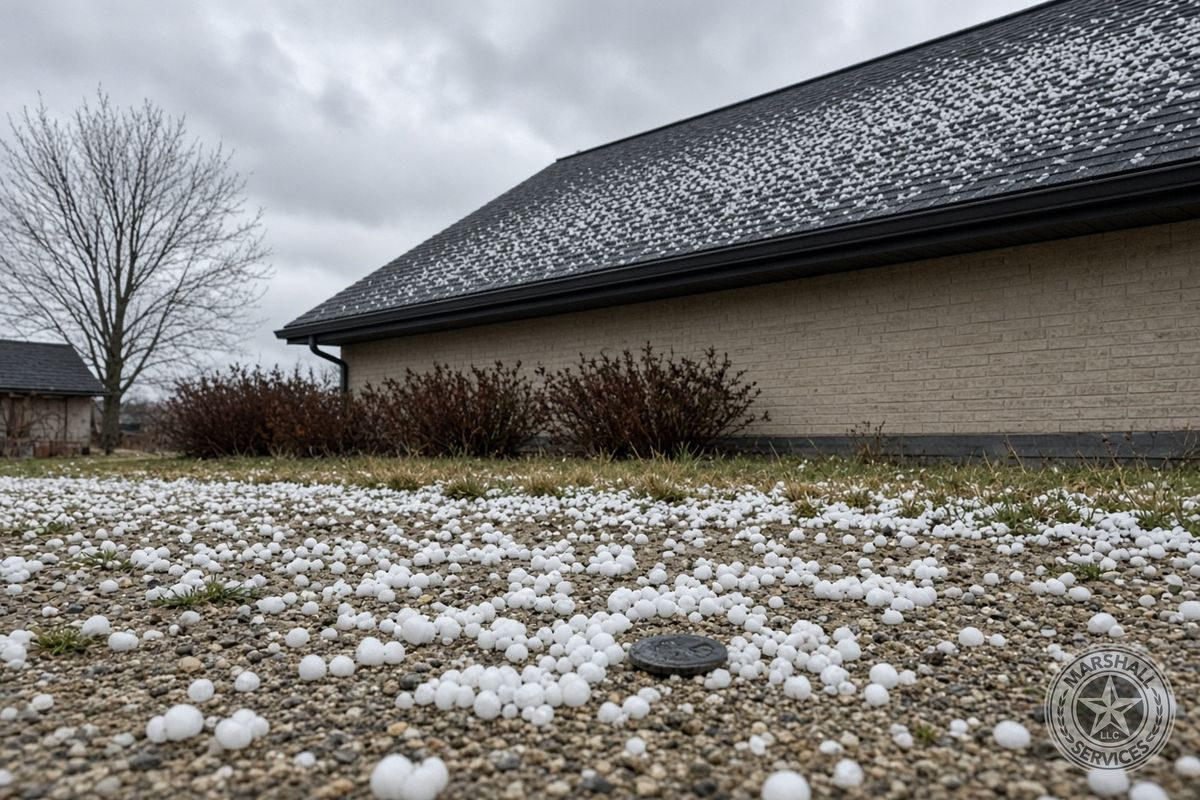
If hail is still on the ground, photograph it next to a ruler before it melts, and do not change the size you measured to match the report. That is the point of this page. A stone in the yard will not wait. A photo with a scale will. The number you write down should be the number you measured, not the number in a storm report.
Look down before you look up
Stones go first. Marks on a roof, a dented gutter, or a torn screen can wait a few minutes. Hail on the ground cannot. If you start on a ladder, the ice may be gone when you come down.
Walk the ground while the stones are still there. Look in the open, then in the shade. Check the north side of the house, the dirt under shrubs, the grass, and the splash zone at a downspout. Open concrete in the West Texas sun clears faster than a shaded strip of soil. Start where the ice is most likely to vanish.
Do not climb a wet roof to photograph stones you can already see from the yard. A fall helps no one. Ground photos are the first pass. A later look at the building, done safely, is a different task. This page is about the stones at your feet.
You are not trying to win an argument. You are keeping a record of what is in front of you before it changes. Sweeping, hosing, and raking come after the photos, not before. If someone is about to clear the walk, ask them to wait. A short pass with a ruler is the record. A bare sidewalk is not.
What the Tahoka report is, and what it is not
The NOAA Storm Prediction Center logged hail up to 1.25 inches near Tahoka on November 14, 2026, a hail report for Lynn County on 2026-11-14.
Source: NOAA Storm Prediction Center
That paragraph is a regional report. It is not a measurement of the stone in your yard. It does not name your house, your roof, or your street. It does not say every property in Lynn County saw the same ice. "Up to" means the top size in that logged report. It is not a number you copy onto your own note.
Your yard can differ. A stone at your feet may be smaller than the logged size. It may be larger. It may be gone. None of those facts is a mistake you repair by editing your note. The report answers what was logged near Tahoka. Your photo answers what you found on your ground.
Keep those records straight when you talk about them. Tahoka, Texas hail in a storm report is a report. Hail on the ground photos at your property are a site record. The logged report is not a label for your file name unless your own ruler showed that size. Most of the time, you should not restate the logged size at all. Point to the report file, and let the report speak for itself.
If you do restate it, restate it as written, and name the source and the date in the same sentence. Do not round it up. Do not round it down. Do not trade it for a coin nickname. The figure in the report stays the figure in the report.
A ruler in the same frame as the stone
Photograph hailstones with a ruler. Put the ruler in the same frame as the stone, on the same surface, with the marks readable. If the marks are blurry, the photo does not show a size.
Lay the ruler flat. Do not hold it above the stone at an angle. An angle can make a stone look larger or smaller than it is. Set the ruler beside the stone, not in a second photo you hope to match up later. Same frame means one image holds both.
Take a wider photo of the spot first, if you can do it quickly. Show the driveway, the grass, or the wall so a later reader can see the stones were at your place. Then take the close photo: one stone, the ruler, the marks sharp. Hail on the ground photos work best as a pair, a wide one and a close one.
If several stones are still there, photograph more than one. Include a smaller stone, not only the largest you can find. You do not need every stone in the yard. You do need the ones you photograph to be shown as they are. A set that shows only the biggest piece is a selected picture, not a plain record.
If you must lift a stone to set it beside the ruler, photograph it where it lay, then take the ruler photo, and write that you moved it. Do not line stones up from large to small before the first photo. That line is something you built. The first photo should show what was left on the ground.
A coin can sit in the frame if a ruler is not in your hand and the stones are melting. A coin is not an inch measurement. Do not convert a coin into an inch size from memory. When you find a ruler, take the ruler photo and keep the coin photo too. Do not delete the first image because the second looks neater.
Use the phone you already have. Tap the stone so the camera focuses there. Wipe water off the lens. Skip filters, beauty settings, and text stamps. Do not zoom so far that the image turns soft. A steady close shot is enough. You do not need a special camera for this step.
White ice on pale concrete can be hard to see. Get lower. Let the ruler's dark marks give the photo a clear edge. If the shade is too dark to read the marks, add a little light, then check the photo before you walk away. If you cannot read the marks on the screen, take it again while the stone is still there.
Write the time while you are still there
While you are standing there, write the clock time, the spot on the property, and the size the ruler showed. Do that before you go inside. A note written from memory an hour later is weaker than a line written with the stone still in view.
The time matters because hail melts. A note with an hour shows the ice was still there then. A note that only says "about the size of the report" does not. If you are unsure of the size, look at the ruler again. Do not fill the blank with a guess, and do not fill it with the report.
Use plain words. Name the spot, the time, whether you moved the stone, and what the marks showed. You might write that the stone in the north bed reached a mark just short of a numbered line, and that you set it beside the ruler after a wider photo. That kind of line is enough. You do not need a form, and you do not need a guessed inch to make the line sound official.
Write the date of the photo as its own date. The photo date and the report date may not match. Stones can sit in shade after the day they fell. If you mention the report in your note, say it is a report, and do not merge the two dates into one. A reader should be able to tell when the ice was photographed and when the report was logged.
Write the clock time, not a guessed size. If the ruler is unclear, write that it was unclear. A blank size is more useful than a borrowed one. You can add a short line about who took the photo, if more than one person was there. Do not let a second person rewrite the size so the notes will agree with each other, or with a printout.
Leave the measured size as you found it
Do not change the size you measured to match the report. This is the step people skip. They see a printout. They want their note to agree with it. They change a measured size. Leave it alone.
The report and the yard are not the same measurement. They can differ. A difference is not an error you need to correct. Your ruler sentence is about your property. The report sentence is about a logged event near town. Mixing them makes a file that cannot explain itself.
Changing the size causes a practical problem. A later reader cannot tell which number came from the ice and which number came from the report. If the photo shows one size and the caption says another, the record disagrees with itself. Keep the caption, the file name, and the note aligned with the ruler, not with the printout.
Do not edit the image to stretch the stone. Do not crop out the ruler. Do not add an arrow and a label that states the report size. Do not rename the file to the report size. Do not throw away a smaller stone's photo because it does not match. Do not shrink a larger stone's note because you think a report sets a cap. It does not.
If you misread the ruler and the stone is still there, measure again. Say what you first wrote, what you saw on the second look, and that the stone was still there. That is a correction of your own reading. It is not a change made to match a report. If the stone is gone, you cannot remeasure it. Keep the first photo and the first number.
Be fair to both sides of a file. A property owner and a carrier both need notes they can check. A size written larger than the ruler is not a better record. A size written smaller, so the note will match a report, is not a better record either. The size you found is the size you keep.
Keep the yard photo out of the report folder
Save the photos in their own folder. Name them for the time and the spot, not for the report. A name like "north bed close ruler" tells the truth. A name that repeats a report size tells a different story, unless that size is truly what your ruler showed.
Keep a copy of the report if you want it. Save the page or print it. Put it in a different folder. Title it as a report, not as your measurement. Store that photo apart from the storm report printout so the two cannot be mistaken for one fact.
People merge files when they are in a hurry. A single packet that opens with your photo and ends with a highlighted report size invites a later reader to treat those as one measurement. They are two records. One is what you photographed. One is what was logged near Tahoka. Say that in a single line when you share them.
Back up the photos before you clear space on the phone. Send them to your own email, or save them to a second device. Melted hail cannot be rephotographed. A deleted image is the same kind of loss. Do this before you organize anything fancy. Two folders and a short note are enough.
When you send the set to your carrier, to a contractor, or to an appraiser, send both records and label them. One sentence is enough. The photos are the stones at the property, with the time taken. The other file is the storm report. You did not change the measured size to match it.
When an amount dispute uses these photos
Hail on the ground photos are documentation. They show what was present, when you saw it, and how you measured it. They are not a repair price. They are not a coverage decision. Whether a loss is covered at all is a separate determination under the policy, made by the carrier and, where the parties disagree, resolved by a court — never by the appraisers or the umpire.
Appraisal determines the amount of loss only. If your policy contains an appraisal clause, that clause is the process the policyholder and the carrier agreed to for a dispute about the amount. An appraisal clause is the policy language that lets either side ask to resolve the amount of loss through appraisal. Check your own policy for its terms. For a legal question, ask a licensed attorney.
If that clause is in the policy and one side invokes it, the steps are plain. Each side selects its own independent appraiser. The two appraisers inspect and share their positions. A position is that appraiser's written view of the amount of loss. If they agree, they set the agreed amount down in an award. An award is the written decision on the amount of loss. If they cannot agree on an item, a neutral umpire decides that item. An umpire is the neutral person who decides only the items the two appraisers do not agree on.
The work rests on the evidence. It does not promise a result, a payment, or a timeline. Outcomes depend on the facts and the policy. Marshall Services is independent. It can serve as the appointed party appraiser or as the neutral umpire, and in both roles the work rests on the evidence.
These ground photos can sit in that file as evidence of what was on the ground. They do not set a dollar figure by themselves. A hail damage insurance appraisal looks at the amount of loss on the property. The storm report is context. Your ruler photo is a site record. Keep them distinct so either side can see what each one is.
For a property in Tahoka and elsewhere in Texas, insurance appraisal in Texas is that amount-of-loss process when the policy provides it. The same photo habits matter for owners across West Texas, including people who look for a Midland insurance appraiser when a hail amount is not agreed. The measured size still stays as you found it.
What to do in the next few minutes
Here is a short order, if stones are still on the ground. Look down before you look up. Take a wide photo of the spot. Photograph hailstones with a ruler in the same frame. Write the clock time, the spot, and the size the ruler showed. If you moved a stone, say so. Do not change that size to match the report. Save the photos apart from any report printout. Then, and only then, clear the walk if you need to.
If the stones are already gone, do not invent a size. Write that they melted or were cleared before you measured. Keep the report in its own file. A gap is better than a borrowed number.
If you want to talk through how notes like these fit an amount-of-loss question, Marshall Services offers a free consultation. Call 972-322-0752. We can explain the appraisal process in plain terms. We do not promise an outcome. Thank you.
Frequently Asked Questions
What if I already swept the hail before I could photograph it?
You cannot rebuild a hail measurement after the stones are gone, so do not write a size from memory to match a storm report. Photograph whatever stones remain, note that the rest were cleared, and describe only what you can still see. A missing photo is a gap. Filling that gap with a report size mixes two records. Keep the report in its own file, and do not rename the remaining photos to a size you did not measure.
Does a photo of hail on the ground decide coverage?
A photo of hail on the ground does not decide coverage. It records stones, time, and the size you measured. Whether a loss is covered at all is a separate determination under the policy, made by the carrier and, where the parties disagree, resolved by a court. Appraisers and an umpire do not decide coverage. If your policy contains an appraisal clause, appraisal determines the amount of loss only. Check your own policy, and ask a licensed attorney for a legal question.
Can I borrow the report size if the ruler marks are hard to read?
An unreadable ruler does not let you borrow a size from a storm report. If the marks are hard to read, take another photo closer to the stone while it is still there, and check that the marks are sharp before you leave. If the stone has melted, write that the scale was unclear and leave the size blank. An unclear photo should stay unclear in your notes rather than become a borrowed number. Save both photos.
Do I need a special camera to photograph hail on the ground?
A phone camera is enough for hail on the ground if the ruler and the stone are sharp in the same frame. You do not need a special lens, a drone, or editing software to make this record. Skip filters and text stamps that would add a size the ruler does not show. Hold steady, fill the frame with the stone and the ruler marks, and save the image before you do anything else. A clear plain photo is the record you can keep.